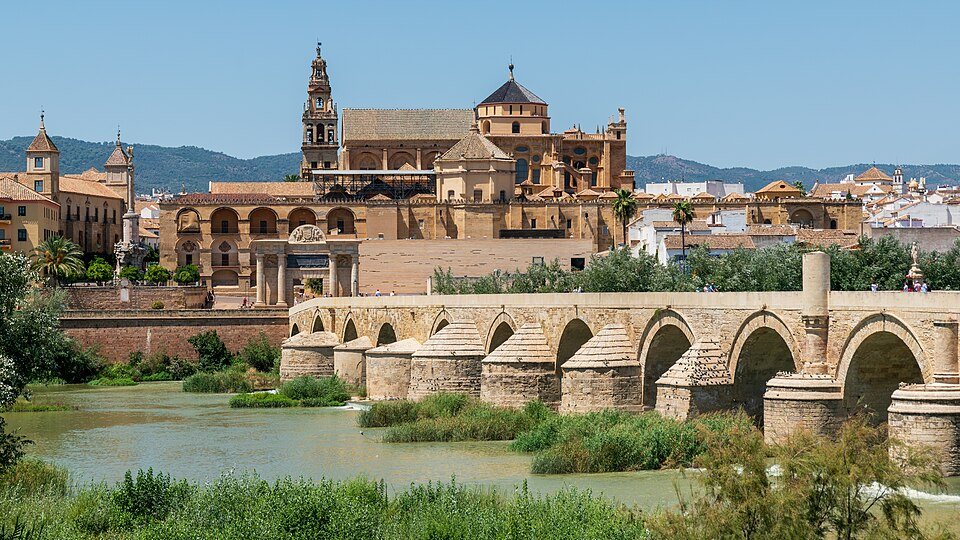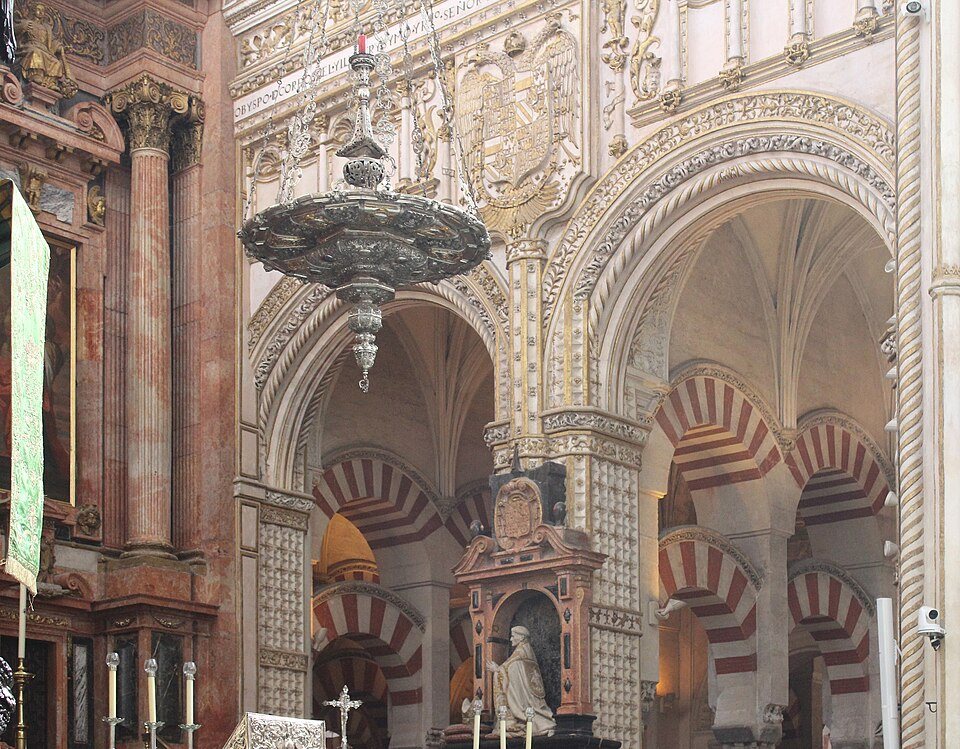
Almost everyone who visits Córdoba photographs the Mezquita-Catedral from the inside: the striped arches, the orange trees, the sudden Renaissance nave rising out of the old prayer hall. Far fewer walk across the Roman bridge to the far bank and turn around. That's the mistake worth not making. The Torre de la Calahorra, a squat fortified gate tower on the south side of the Guadalquivir, is the only place in the city where you see the whole building — minarets, buttresses, dome, river, bridge — stacked together in one frame. From inside the old quarter, the streets are too narrow and the Mezquita too large for that to happen.
Why the view only exists on this side of the river
Córdoba's historic center is flat and dense. The Mezquita-Catedral occupies a full city block, and its own perimeter walls keep you close enough that you only ever see one face of it at a time — a wall, a gate, a corner of the bell tower. The land simply doesn't rise anywhere nearby. The south bank of the river is different: the Calahorra sits on slightly raised ground, separated from the old city by open water and the long run of the bridge, which gives enough distance for the whole monument to resolve into a single silhouette. Add the river in the foreground and, at the right hour, its reflection, and you get the postcard image of Córdoba that's actually hardest to stumble onto by accident. ⭐ Go in the late afternoon. The light comes from the west, over your shoulder as you look back at the city, and it puts the Mezquita-Catedral's bell tower and the river in warm, even light rather than silhouette.
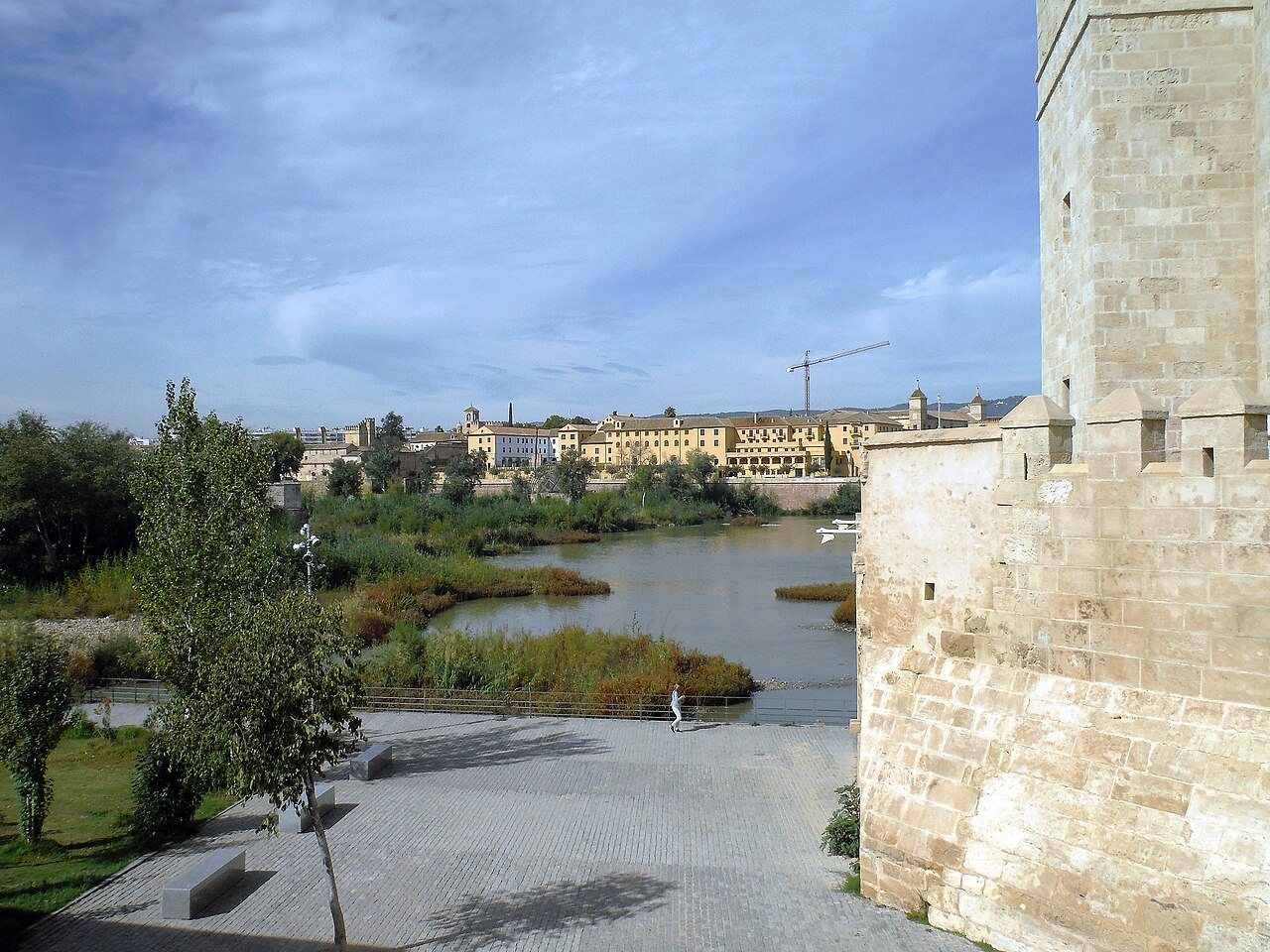
The tower itself predates the current bridge crossing by centuries in function if not in fabric — a fortified gatehouse has guarded this end of the crossing since the Islamic period, rebuilt and reinforced under Christian rule in the 14th century, which is roughly the structure that stands today. It was built to control who crossed the river, not to be admired from across it, which is part of why it's easy to underestimate from ground level: it's a defensive block, not a landmark silhouette.
What's actually inside
The tower houses a small museum, generally known as a "living museum of Al-Andalus," built around the idea of medieval Córdoba as a meeting point of three religious and intellectual traditions. Expect figures and reconstructions representing scholars associated with the city in that period — names like Averroes, Maimonides, and Alfonso X come up — along with models and explanatory material on the era's philosophy, science, and the city's role in transmitting classical and Islamic learning onward into Christian Europe. Specific claims about population size or the scale of any library from that era are disputed among historians, and the museum's framing is more thematic than a hard chronology, so treat anything numerical you read on the panels as one account among several rather than settled fact. The displays are modest in scale compared with the building's reputation — this is not a large museum, and most visitors spend less time with the exhibits than with the stairwell. That stairwell is the real destination: narrow stone steps wind up through the tower's three levels to a rooftop terrace, which is where the river-and-Mezquita view actually opens up. ⚠️ The stairs are tight, uneven in places, and not a good fit for anyone with mobility issues or a fear of enclosed spaces — there's no elevator.
Getting there without wasting the trip
The tower sits at the southern end of the Roman bridge, directly opposite the Puerta del Puente gate on the old-city side. The walk across the bridge itself, car-free and usually busy with other pedestrians, takes a matter of minutes, which makes this one of the easiest add-ons to any day based around the Mezquita-Catedral — there's no separate trip required, just a decision to keep walking south instead of turning back into the old quarter. Admission is ticketed, with the mechanism — a desk inside the entrance, sometimes a combined pass with other sites — and the operating days and hours both prone to seasonal change, so check current details directly with the site before planning a visit around it rather than around the rest of your day. The same goes for cost: confirm it on arrival or through the official information channels rather than assuming. ⭐ If you only have time for the rooftop and not the exhibits, that's a reasonable way to use the visit — the terrace is the part people remember.
Pairing it with the rest of the riverfront
Because the tower sits at one end of the bridge, it naturally pairs with a slow walk along the river itself rather than a quick there-and-back. Looking north from the Calahorra's rooftop, you get the Mezquita-Catedral and bridge together; walking back across and turning to look south, you get the tower from the bridge deck instead, low and fortress-like against the water. Either direction, the river is doing most of the work in the composition, which is worth building time around rather than treating as a corridor to cross quickly. If you're approaching from the Jewish quarter side of the old city, it's a straightforward continuation from the Judería and synagogue down to the Puerta del Puente and across. Coming from the opposite direction, a day trip itinerary that already includes Medina Azahara can still fit the Calahorra in on return, since it sits right at the edge of the old city rather than requiring a detour into it.
The one thing people get wrong
The most common error isn't missing the tower — plenty of visitors see it from a distance, assume it's just a bridge fortification, and don't cross over. The building reads as utilitarian from the city side: gray stone, small windows, no obvious grandeur. The payoff is entirely on the far side and on the roof, not in the approach. If a view of the whole Mezquita-Catedral together with the river and bridge is something you actually want for your own memory of the city rather than for someone else's photograph, this is the one spot in Córdoba built to give it to you, and it's a ten-minute walk from the cathedral doors to get there.
In pictures